
December 2025
Welcome to EFM's December Newsletter!
Read, Count, Play – Every Child, Every Day!
It is essential that every caregiver in the world reads books and does math with their young children!
EFM believes in every child’s mathematical right to equity, opportunity, and personal fulfillment.
News
Donations – This month we received a generous donation of $10,000 from a new fan. We are very thankful for all the support we have received this year, which now totals a little over $25,000! These donations make a huge difference for paying for things we are doing, such as our new website (likely to be available in January), and things we are now able to consider doing. Please donate your money, time, or talent to help EFM with its mission to bring better early math education to the world.
Early School Math app – Our free ESM app is much improved. We have fixed some bugs and made some performance improvements, and we have added a great deal of new material (with more being added every week). ESM now has material for single-digit multiplication and division, 2-digit addition and subtraction, simple fractions, measurement, and data – this in addition to 150 puzzles, 80 classroom games, 25 rich tasks described in detail, and many short instructional routines. You can play with it in any browser by using this link: early-school-math.web.app. We would very much like to get your feedback on what we are doing well and what ideas you have for improving it – please contact me. Please help us help math teachers all over the world.
Joy and Beauty
Holidays celebrate joy, beauty, and thoughtfulness. Sadly, most people do not associate joy and beauty with mathematics. I will start with three cautionary tales and then describe ways of making mathematical joy and beauty more front and center.
Tale 1. Country X
Because the problem is so widespread, and because I don’t want to single out one country for a problem that is almost world-wide, I am not going to name the country involved in this short tale.
Recently I was talking about using the Early School Math (ESM) app with an educator involved with hundreds of schools in a particularly poor section of country X. The educator told me that the great majority of their students feared math, felt anxious about it, and felt incompetent at it. The math skill levels of these students was quite low, and their teachers were not strong at teaching math.
My heart aches when I think of the tens of thousands of children going through those schools who are not getting the lifetime of benefits, both practical and personal, that learning real mathematics could bring them, and not learning how fun and beautiful math can be.
Tale 2. Consultant Y
Someone I know is a professional development consultant for teachers of early mathematics. After a meeting with a group of teachers, he did one-on-one interviews with several of them. I believe the subjects for the day involved teaching quantities and fractions. He reported that most of the teachers he talked with confided that they didn’t feel confident enough with the material to incorporate his ideas which were more playful and that put their students more in the “thinking zone” (to use Peter Liljedahl’s terminology). He said the teachers’ plan was to take the safer and simpler approach of going lesson by lesson without deviation through their uninspiring textbook.
Teaching is a time and energy consuming job that is very demanding. It is a lot to ask of these teachers to teach math in ways that they did not experience as students and have not seen used in other classrooms.
Tale 3. Student Zed
I don’t do much math tutoring these days. However, when a friend of mine said their child, Zed, was failing a middle school math course, I couldn’t say no. Beyond the many math skills that Zed had never really learned, the most striking thing to me was that Zed found absolutely nothing to like about math. To Zed, math was a subject devoid of fun and interest.
Bringing the Joy and Beauty of Math
If they adopt and beta test ESM, the change for country X’s students will come, but not overnight. Also, I am too far removed from consultant Y’s teachers to do much for them anytime soon. But … I can make a difference in Zed’s life today (the optimism of every teacher).
I realized that changing Zed’s attitude about math was as important as cleaning up his mathematical weaknesses. I couldn’t expect him to apply himself to a subject that he saw as uninteresting and boring. I decided to spend half of our sessions playing math games and puzzles so that he would see what math really had to offer and to practice some math skills as we played.
Nim
During our first session’s “break” we played the game of Nim. To play, set the target number to 10 (or whatever you want). In the subtraction version, the players take turns subtracting 1 or 2 from the current total (that starts at the target). The player who reaches 0 on their turn wins. Its quick to learn and to play.
After we played two rounds of the game, I saw him smiling for the first time since we sat down together.
One of things I like about Nim is that it is an excellent teaching game for the problem solving strategy of learning from simpler examples. After we went through how to learn from simpler examples (using targets of 1 up to 10) to become a Nim Master, he wanted to play more games.
By the way, learning from simpler examples is one of the most effective problem solving strategies I know. After introducing the strategy in Nim, I could then revisit it time and again in our puzzle solving and in his learning of some basic math skills.
The Product Game
After returning to work on math skills with renewed energy, the game we played during the next break was The Product Game.
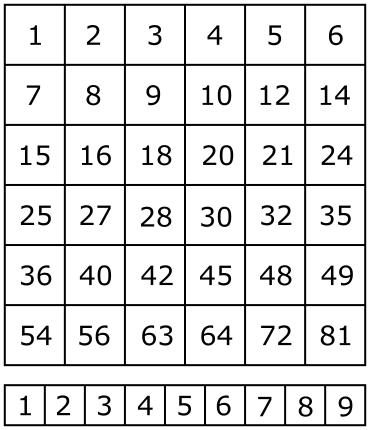
This is played by moving around two counters on the bottom row of 1 to 9. To start, the first player puts down a counter somewhere on that row. Then the second player puts down a second counter anywhere on that row and also claims the square that is the product of the two counters. Thereafter, the players take turns moving either one of the counters and claiming the product by placing one of their markers on the square. The first player to get three of their markers in a row, column, or diagonal wins.
I like this game because there is no simple strategy. It allows the players to focus on factoring the numbers to either block or attack, and this factoring encourages thinking about common factors shared by the numbers involved in the action. Lots of multiplying and factoring, and lots of fun as players alternate between offense and defense.
Teetering Towers Solitaire
On the second day we played Teetering Towers. I wanted him to practice number sense with the size of fractions. This is really a solitaire game, though it can be played competitively.
A player starts with a tower of three empty slots to fill. Two dice are rolled and a fraction is made from the two numbers by using one number as the numerator and the other as the denominator. That fraction is placed in any of the empty slots and cannot be moved. If all three slots are filled with fractions in order from least on top to greatest on the bottom, the player starts the game anew with an additional slot. If the player does not succeed in filling the slots in order, the tower is said to have fallen over, and the player starts again with one less slot. The goal is to succeed with a tower as tall as possible.
In this game, things will always eventually go wrong, and this inevitability removes any sense of failure. It provides a lot of playful practice with ordering fractions. It can also be used with two-digit numbers to practice ordering those numbers.
EFM Puzzle Playing Cards
We ended our first session by picking one of the EFM puzzle playing cards from the deck for grades 2 to 5. In subsequent sessions we continued picking puzzle cards. Here are a few of the ones we played with:
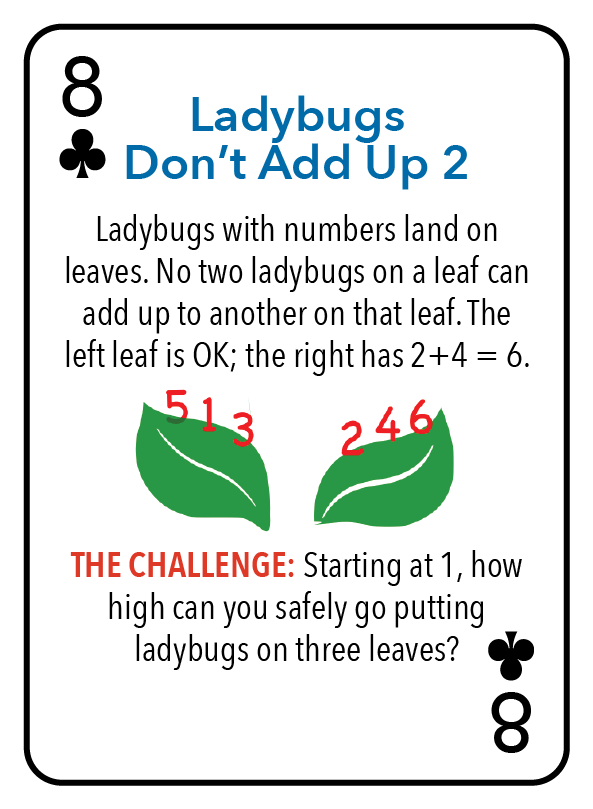
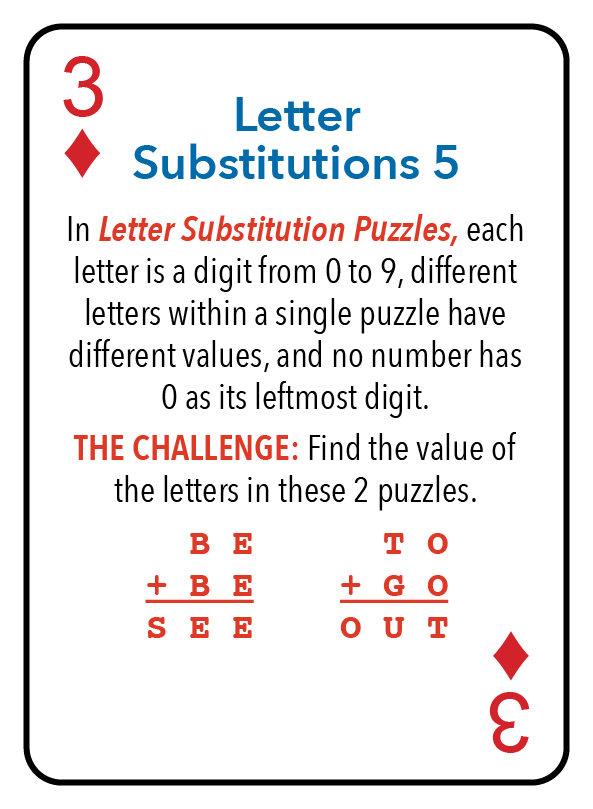
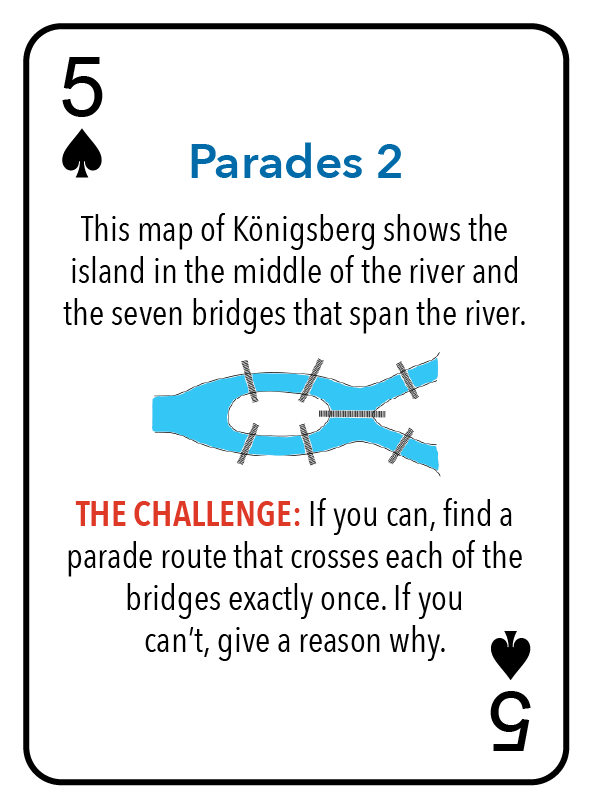
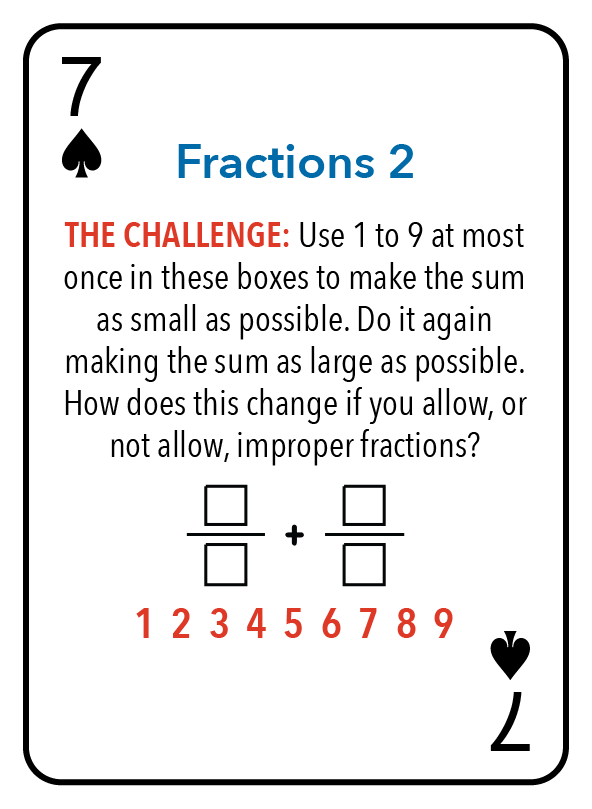
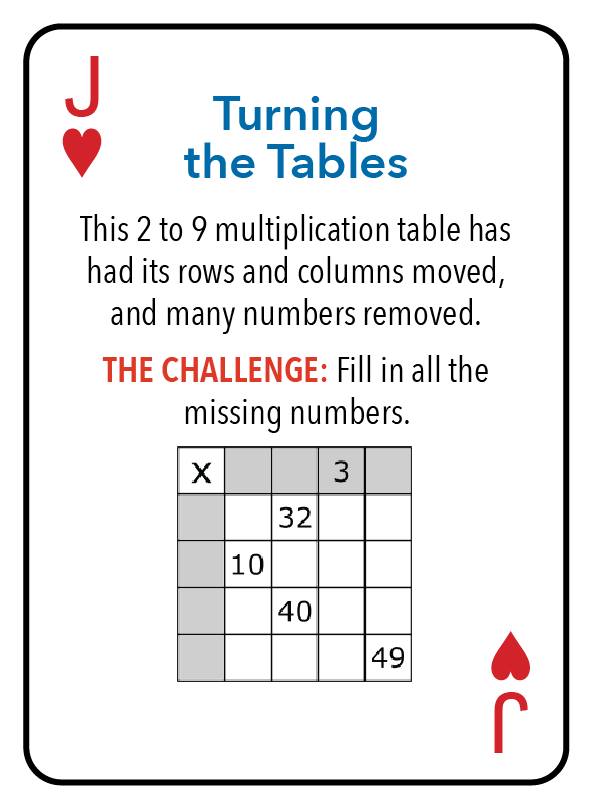
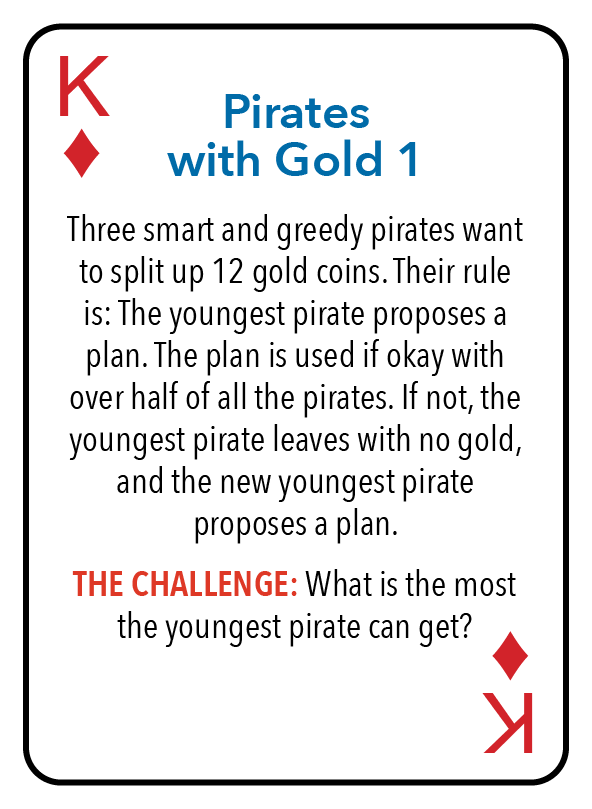
The 8 of Clubs and 3 of Diamonds were entirely for fun.
The 7 of Spades gave us a chance to discuss what made fractions larger or smaller. The Jack of Hearts developed some number sense about factoring.
The King of Diamonds and the 5 of Spades provided opportunities for talking about problem solving and using the strategy of looking at simpler examples and finding patterns.
For the Bridges of Königsberg (5 of Spades), we looked at a lot of graphs and looked for patterns. By the end he was desperate to find out why the Bridges puzzle was impossible – he was filled with curiosity and interest.
The student who had disliked math all his life was now seeing what a wonderful subject it could be!
Games and Puzzles
After more than a month, Zed comes in each time to ask if we can pick another puzzle playing card and play more math games. He still has many math weaknesses that we work on half the time, but his interest and energy level for improving those skills is so much better than the middle schooler who walked into my home on our first day. Zed’s parent commented after Zed and I went 90 minutes on one of our sessions that Zed had never been able to sit down and do math for even an hour before that.
I wish that meeting with me was not the first time in Zed’s life that he had fun with math. I wish Zed’s teachers had been doing this with him and his classmates all along.
My Hopes
My hope is that what Early Family Math and other organizations are doing for families and educators will make a huge difference in these young people’s lives. I hope that these ideas will find fertile ground in the teachers that Consultant Y works with and those teachers will take the leap into teaching math in new ways. I hope that Country X will adopt ESM and bring new math into their schools – math that will fill their students with confidence and a love of math, and that will help those students see the Joy and Beauty of math.
Alex Box
Speaking of people who bring Joy and Beauty, Alex was my friend and colleague at EFM who died two months ago. I want to take a moment to celebrate her.
Her website, Maths Play, was focused on making math playful and engaging. Through her website, her work with students, and her work with other teachers, it was always a central aim for Alex to share all the wonder, fun, and beauty that math has to offer.
We had many enjoyable Zoom calls sharing beautiful things about math and discussing ways to make it playful. One high point for me came when Alex and I coauthored the December, 2023, issue of this newsletter. It was one of my favorites. We wrote about our three favorite books connected with mathematics and math education.
I remember Alex with great affection and I miss her dearly. She was a wonderful, caring person who brought mathematical play and joy into many people’s lives.
Wrapping Up
I hope you and those you care about have wonderful times together during these holidays. I hope that some of those times include playing math games and solving math puzzles, and that you find much joy and beauty together in that math. If you feel inspired to collaborate with EFM to help make this happen for more families and classrooms, please contact me and let’s explore the wonderful things we can do together.
If you have any questions or comments, please send them our way! We would enjoy the opportunity to chat with you. Also, if you are interested in collaborating with us or supporting us in any fashion, we would love to talk with you about ways we can work together!
December 18, 2025
Chris Wright
Chris@EarlyFamilyMath.org
Twitter | Facebook | Instagram
Early Family Math is a California 501(c)(3) nonprofit corporation, #87-4441486.