
March 2026
Welcome to EFM's March Newsletter!
Read, Count, Play – Every Child, Every Day!
It is essential that every caregiver in the world reads books and does math with their young children!
EFM believes in every child’s mathematical right to equity, opportunity, and personal fulfillment.
Eleventeen, and Other Brilliant Mistakes
Have you ever heard “twelveteen” or “twenty-ten” from your little one? I recently talked with another parent who shared how her 4-year-old son recently wanted to count all the way to 100. I asked, “Has he ever said something like twenty-ten?” She laughed—yep! And then we talked about why that kind of “mistake” is actually a sign of deep learning in progress.
Here’s another specific moment from my family. Both of my daughters love to swing, to the point that it’s a challenge to get them to engage in other activities at playgrounds.
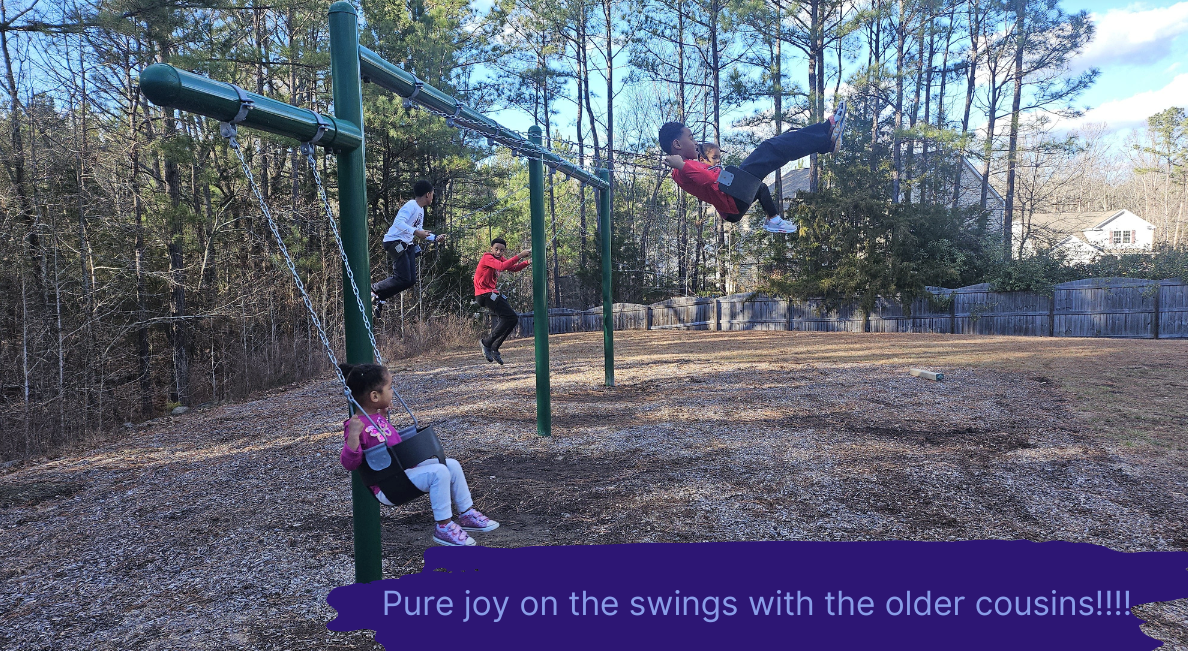
On an outing to the park when my daughter Jonylah (Jo-NYE-lah) was two years old, in an attempt to get her to move on from her swing I said, “I’ll swing you twenty more times before you get down.”
Jonylah began to recite the number sequence and made it accurately through ten, then continued on “eleventeen, twelveteen…”
The unexpectedness of hearing something other than “eleven” after ten made me laugh, and once we made it to 20th push, Jonylah did not easily or happily move on to another activity (imagine a stereotypical two-year-old tantrum and you’ve got the picture). The moment slipped from my mind as I responded to the resulting big toddler feelings and cries of “I don’t want to get down!”
Later though, I thought about this moment again and what it reveals about what Jonylah knows. As we get further into the English number sequence, we get to a repetitive pattern of a number followed by -teen (sixteen, seventeen).
Saying ten, then “eleventeen” is what as a teacher I would have classified as a brilliant mistake. Although incorrect, it shows that Jonylah has recognized a pattern and is attempting to apply it more widely - what a wonderful ability to already possess at the age of 2!
Do you remember learning to count? I doubt any adult does! Because learning these skills is so far behind us, we think of counting as easy and straightforward. Once something becomes so deeply ingrained in us as to become second-nature, we can’t help but lose sight of its complexity. Let’s look at how many components are at play to become what we can call a “conceptual counter.”
In order to master counting, there are multiple sub-skills that must be learned and connected, such as:
Verbal number sequence (one, two, three, etc)
Accounting for the actual quantity present
Symbolic representation (the digits 0-9 that we use in our base-10 number system)
This “What’s Your Child’s Counting Stage?” overview can give you a sense of the progression of counting skills.
With my own daughters, I notice they don’t move through the stages in a perfectly linear path. Sometimes they show signs of being at a couple of stages at once, or sometimes they are at a stage but only up to a particular quantity - Jonylah’s one-to-one correspondence is solid up to 5 but gets spotty after that.
What stages are you seeing show up in your child right now? Have you heard any similar brilliant mistakes? I’d love to hear about them! Drop me a note at erin@rootsandwingsmath.com.
You can also consider subscribing to either or both of my other ongoing newsletters:
Roots and Wings Math Educator Newsletter (geared towards K-8 teachers)
Roots and Wings Math Parent Newsletter (geared towards parents of preschool-age children)
Wishing you many happy math moments in the month to come,
Erin
Erin Wahler-Cleveland is the founder of Roots and Wings Math and a board member of Early Family Math.
Twitter | Facebook | Instagram
Early Family Math is a California 501(c)(3) nonprofit corporation, #87-4441486