
February 2026
Welcome to EFM's February Newsletter!
Read, Count, Play – Every Child, Every Day!
It is essential that every caregiver in the world reads books and does math with their young children!
EFM believes in every child’s mathematical right to equity, opportunity, and personal fulfillment.
News
Early Family Math app – There is a new version of the EFM app in the app stores. The app now has a dozen languages almost all of which are complete. Perhaps you’ve been wanting to read some children’s stories in Turkish or Japanese – now is your chance.
Right and Wrong
Over the years, I’ve had many people tell me they like math because there is just one right answer. You arrive at an answer, and you are told it is either right or it is wrong. No ambiquity or room for opinion.
Despite the comfort this provides, this focus on right answers brings out the worst that mathematics has to offer!
A Destructive Measure
Measuring a person’s mathematical worth by their ability to get right answers is tempting in its simplicity and ease of application. It also fits the limited understanding of math most people have. It is important to be accurate when doing calculations, so why not emphasize this trait?
The problem is that giving this measure so much prominence causes harm at many levels.
Misguided caregivers push flashcards, worksheets, and gamified electronic apps to create calculational accuracy, hoping this will lead to success in school. Unfortunately, this has the opposite effect – children who see an impoverished version of math want nothing to do with it.
This measure creates destructive goals in school. Students’ sole mathematical focus is to get right answers on tests to get good grades and advance to the next level. Teachers and schools need their students to get right answers on standardized exams to prove the teacher and school are doing their jobs well.
Using this measure pulls our focus away from where it should be. The philosopher C. Thi Nguyen calls this “value capture” – we lose sight of what’s valuable and beautiful about mathematics when we focus on this bureaucratic and simplistic metric. Worse yet, not only does it trivialize mathematics, it has unfortunate social consequences. Students and teachers are afraid of getting wrong answers and feeling stupid in front of others, and this leads to incredible anxiety and shame.
There is a better way!
Play With It!
The best way to experience math is to play with it fearlessly and with abandon. Get into the middle of it, wrestle with it, notice all sorts of things both expected and unexpected, struggle with it, exalt in the beautiful things you discover in it, and be amazed by what you learn about yourself.
When children play with pattern blocks, they discover how polygons fit together and how patterns of shape and color can be created. No one told them to find the correct answer; they are playfully experiencing the beauty of mathematics and they are loving it.
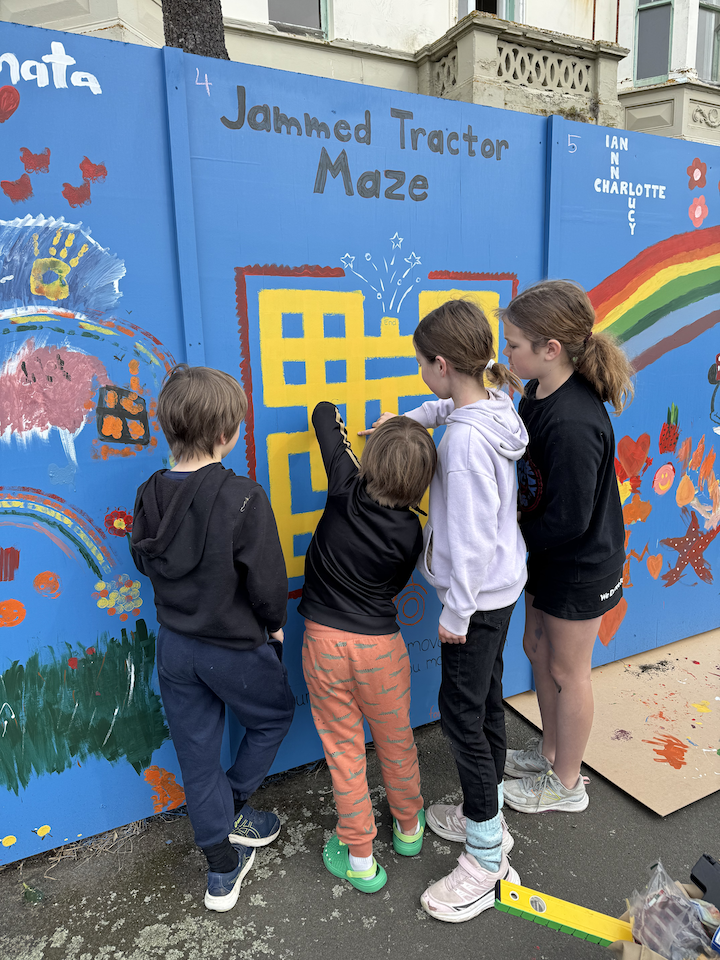
Here are four children spontaneously trying to solve a maze puzzle they found on a construction fence. They are working together, sharing ideas, and having fun without concern for being right or wrong.
Celebrate Mistakes, Questions, and Partial Solutions
To play and engage wholeheartedly with math, change your relationship with making mistakes, having questions, and presenting partial solutions. Create an environment that encourages free-flowing and lively discussions. This requires effort and intention. Adults must model and promote these attitudes and practices for children to adopt them.
Everyone makes mistakes, so there are plenty of occasions to normalize and destigmatize them. A mistake made openly creates an opportunity to explore methods and practices that are otherwise difficult to uncover. Create a confident, playful environment where ideas are put forth without fear of being wrong.
Asking questions is essential for understanding problems and ideas. Children afraid to ask questions for fear of looking stupid, often waste time solving the wrong problem. When a child asks a question, you do not need to be the answer person. Use the question to start a discussion with the questioner or the whole group.
Many children have the idea that a partial solution is the same as having no solution. Partial solutions can be essential – sometimes everyone is stuck and a partial solution is what’s needed to move ahead. Respectfully listening to and working with partial or potential solutions is at the heart of creating a collaborative atmosphere.
Explore Freely and go on a Wonderful Journey
If you are only interested in finding the right answer to the current question, then you will miss wonderful mathematics that is right in front of you.
Over the holidays, my granddaughter, Claire, and I were playing with some EFM puzzles.
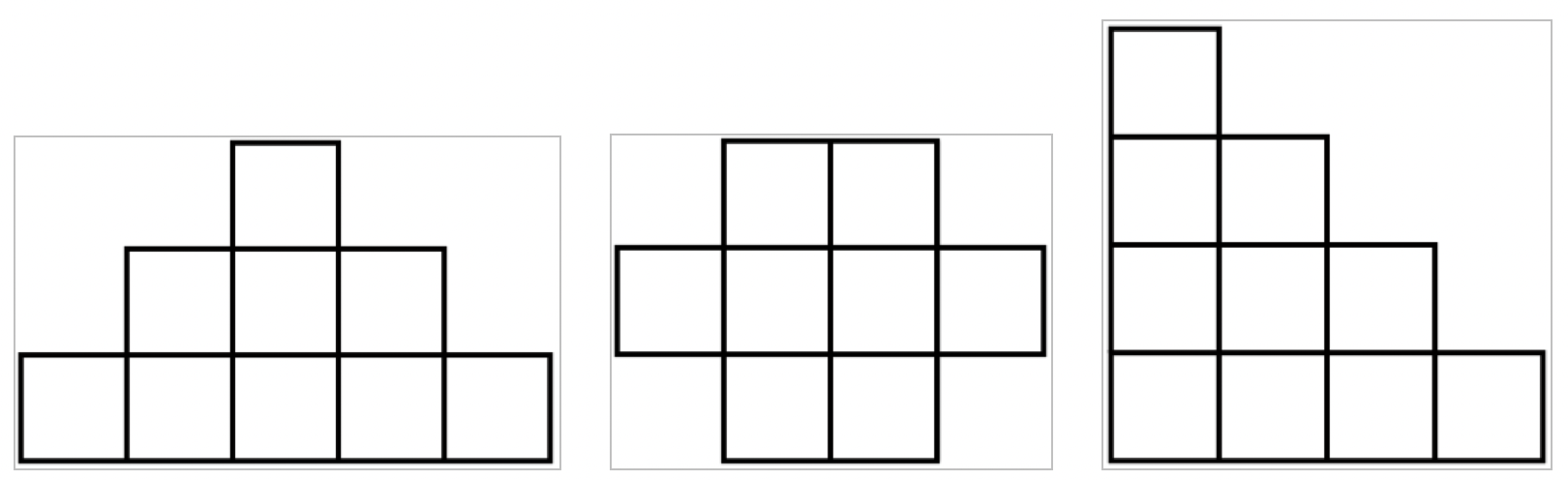
We started with the consecutive number puzzles pictured above. The challenge is to put the numbers starting with 1 into the squares so two consecutive numbers never touch along their sides or corners.
Claire sat paralyzed, not sure where to start, not wanting to make a mistake. For her, embarrassment and shame often accompanied making a math mistake, and she wanted to avoid that at all costs. It was better to be silent than to make a misstep.
I encouraged her to choose a number and put it somewhere, anywhere, and see what happened. I said it might work or it might not – either way we would learn something that might get us closer to figuring it out. Mistakes were no longer mistakes, they were just experiences that got us closer to understanding the puzzle.
Bit by bit she relaxed and started trying things. Her eyes lit up when she realized that the two end numbers (1 and the largest number) were the easiest to place and should be put in the trickiest spots. She experienced that unmistakable Aha Moment when she saw how all the numbers could fit together.
We went on to create new grids of this type to challenge each other. We explored why some of the grids had no solutions. We looked for side paths and extensions to the original puzzles that might yield more mathematical fun.
Claire’s Next Great Adventure
The next day we played with the numbered ladybug puzzle shown on this EFM puzzle playing card.
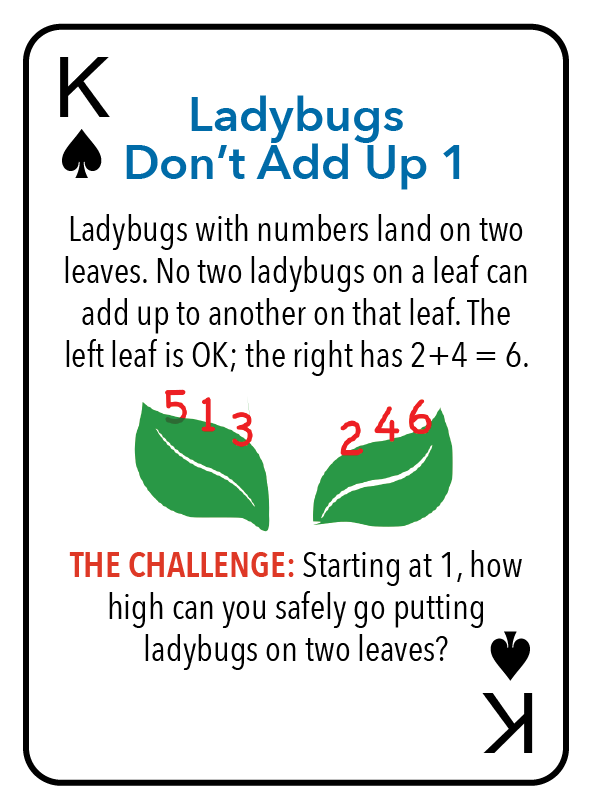
After the previous day, Claire was much more comfortable trying out experimental placements of numbers. However, there was addition involved for this puzzle, and once again I saw her hesitancy surface.
I could tell she immediately knew the answer to additions such as 2 + 4. Despite her ability to do it, she was quiet for a while giving herself time to check her answer internally two or three times before offering an answer. Imagine the experiences she must have had that led to her holding back for so long so she could feel safe. What a shame she couldn’t exuberantly say “6” and go running forward in the puzzle.
Her confidence in giving adding answers gradually increased, but I could tell changing her confidence was not going to change in a single day.
We transitioned the puzzle to a game version where you alternate turns and try to trap the other person to not have any legal move. Next, we looked at what happens for 3 leaves. We also explored what happens if you only use even numbers or odd numbers or Fibonacci numbers. Some of the directions of exploration were dead ends or were uninteresting, but others were beautiful. It is similar to exploring in a new park and finding the pathways that you particularly like.
One Last Example
Suppose you were asked to add up the numbers from 1 to 9. You could of course just do the additions and arrive at 45. However, look what happens if you decide to play around with it a bit and not just stop with the right answer.
When you add several numbers, it’s often handy to find 10s or other convenient numbers. There are lots of 10s in this problem. 1 + 9 = 2 + 8 = 3 + 7 = 4 + 6 = 10. There are four 10s and 5 left over, which is a fun way to get 45.
What happens when we do this with other number ranges? We can add up the numbers from 1 to 20 by forming 10 pairs of numbers that add up to 21 – do you see how to do it? This quickly gives the total 210. A legend describes how, as a young boy, the famous mathematician Gauss added up the numbers from 1 to 100 and arrived at the answer of 5050 in less than a minute.
Another way to add these numbers up is to overlap them with their numbers summed in reverse. This produces two rows:
1 + 2 + 3 + 4 + 5 + 6
6 + 5 + 4 + 3 + 2 + 1
If you sum each of the six columns this becomes 7 + 7 + 7 + 7 + 7 + 7 = 6 x 7 = 42. We doubled the sum when we created two rows, so the answer is 42 / 2 = 21. Using this thinking, create the general formula for the sum of the numbers from 1 to n as n (n + 1) / 2 – that is, we’ll have n sums of n + 1, and then we’ll need to divide by 2. A simple and general formula – pretty cool!
This journey is just getting started.
If you have six people shaking hands, how many handshakes in all will there be? One way to look at this is that the first person shakes 5 hands, the next person shakes 4 hands (not including the 1 we already counted), and this continues down to 0. That is, we have our old friend 5 + 4 + 3 + 2 + 1 + 0 handshakes. We can count the handshakes in another way. Each of the six people shakes the hand of five other people, which gives 6 x 5 handshakes. However, we counted every handshake twice, so the actual numbers is (6 x 5) / 2. Same formula, how lovely!
Having two different ways of calculating the same thing often produces some interesting surprises.
Which new pathways can you find and explore in this math playground? What happens if you add up only the consecutive odd numbers? What about even numbers? What about square numbers? What about cubes? What about Fibonacci numbers or every other Fibonacci number? Sometimes you’ll find beautiful patterns emerge and sometimes it will be less exciting, and that too is part of the fun.
Wrap Up
Math has so much to offer beyond its basic right and wrong answers. When right and wrong fall away, room opens up for playful gatherings where the exchange of ideas and a sense of exploration and wonder move to the front. I hope you and those you care about have many wonderful mathematical adventures together!
If you have any questions or comments, please send them our way! We would enjoy the opportunity to chat with you. Also, if you are interested in collaborating with us or supporting us in any fashion, we would love to talk with you about ways we can work together!
February 18, 2026
Chris Wright
Chris@EarlyFamilyMath.org
Twitter | Facebook | Instagram
Early Family Math is a California 501(c)(3) nonprofit corporation, #87-4441486.